

What Is a Play Yard and How Does It Keep Your Baby Safe?
So, what exactly is a play yard? Think of it as your baby's very own portable, secure home base. It’s a multi-purpose haven designed to give them a safe spot for both playtime and naptime, offering you some much-needed peace of mind by ensuring the materials and environment are gentle on their delicate skin.
Your Baby's First Safe Space for Play and Rest
A play yard is so much more than just a box to put your baby in. It's a thoughtfully designed environment that creates a contained, hazard-free area where your little one can safely explore, move around, and develop those crucial motor skills. Instead of worrying about every corner and outlet in a room, you have one central spot you know is secure and made from baby-safe materials. This gives you a moment to tackle daily tasks, confident that your child is safe from both accidents and skin irritants.
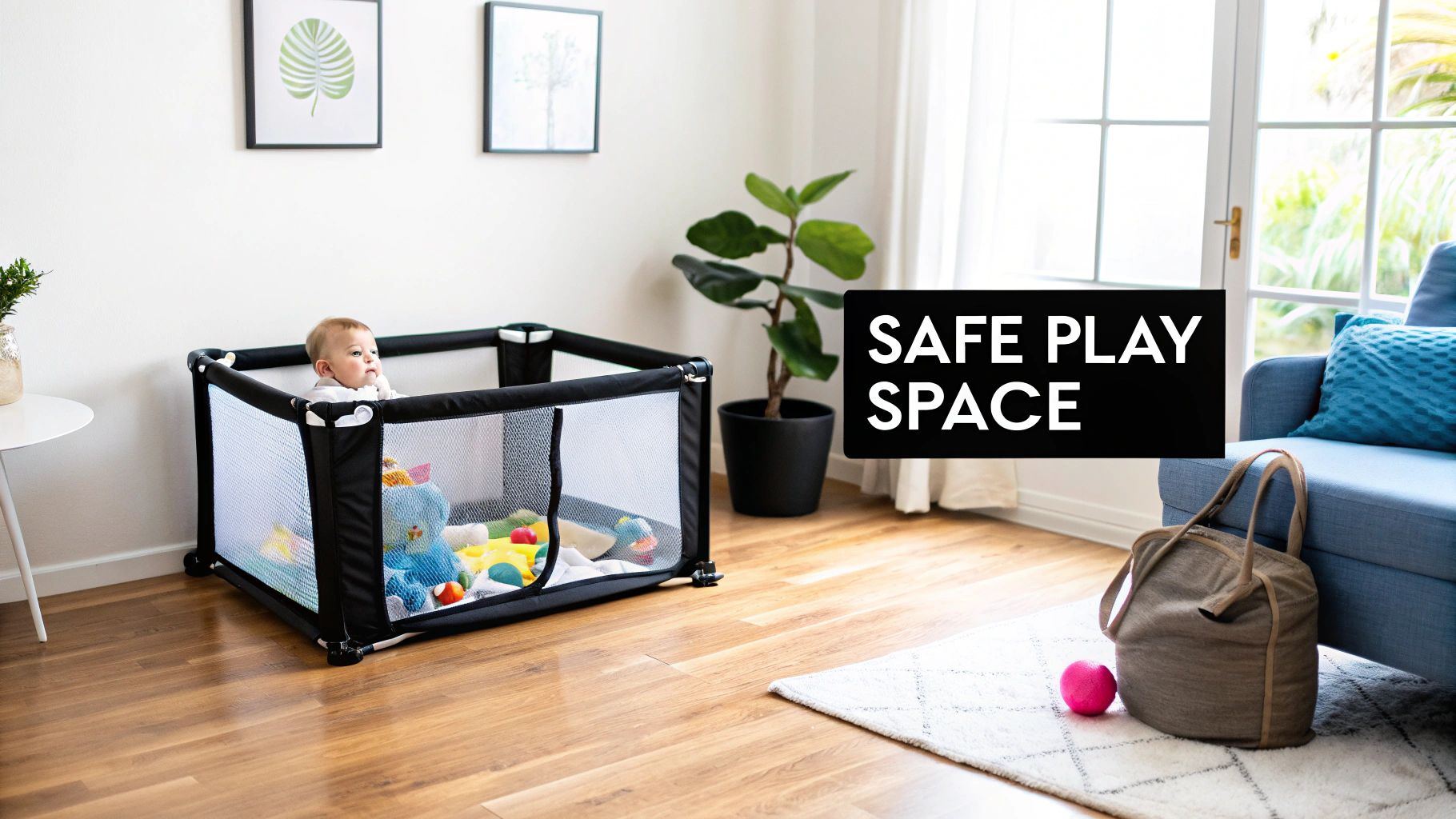
The main job of a play yard is to create a protective bubble for your baby. This becomes incredibly important as they start to get mobile—learning to roll, crawl, and eventually pull themselves up to stand. It’s a simple solution that avoids the need to baby-proof an entire house from top to bottom.
To give you a clearer picture, here's a quick rundown of what a play yard offers.
Play Yard at a Glance
| Key Function | Primary Benefit for Parents | Ideal Use Case |
|---|---|---|
| Contained Play Area | Peace of mind to handle tasks | Keeping a mobile baby safe in the living room while you cook. |
| Portable Sleep Space | A consistent, safe bed on the go | Naps at a grandparent's house or during a weekend trip. |
| Multi-Functional Hub | One piece of gear does it all | Using attachments like a bassinet or changer for an all-in-one baby station. |
This table shows just how versatile a single piece of baby gear can be for busy, modern families.
The Evolution of Baby Safety
Today's play yards are a far cry from their older counterparts. Manufacturers now focus heavily on meeting the highest safety and quality standards, prioritizing materials that are not only tough but also gentle on a baby’s sensitive skin. This helps prevent common issues like rashes or reactions from harsh chemicals or scratchy fabrics.
You'll find that most quality play yards share a few key features:
- Breathable Mesh Walls: These are fantastic because they give you a clear line of sight to your baby and ensure plenty of airflow, which helps reduce the risk of overheating or suffocation.
- Sturdy, Stable Frames: A solid frame is non-negotiable. They're designed to stop the play yard from tipping or collapsing, even when your little one gets more active and starts pulling up on the sides.
- Non-Toxic Materials: Reputable brands make a point to use materials free from harmful substances like phthalates, lead, and BPA. This focus on non-toxic, hypoallergenic materials is crucial for protecting your baby from developing skin allergies or rashes.
This commitment to safety is what elevates the play yard from a simple convenience to an essential piece of baby gear.
A play yard, often called a playpen, is a portable enclosed space designed for safe play and sleep for infants and toddlers. Its dual-purpose design makes it incredibly versatile for modern families.
And it’s true—its role goes way beyond just playtime. In fact, a recent in-depth industry report found that 72% of U.S. parents also use play yards for sleep. This is because they offer a firm, flat surface, which aligns with pediatric recommendations that have been in place since 1992 to help reduce the risk of SIDS.
Ultimately, understanding what a play yard is means seeing it as both a developmental playground and a protected sleep area. Choosing a high-quality model is a crucial first step, and you can learn even more by checking out our guide on creating a safe sleep environment for infants.
So, What Are the Different Types of Play Yards?
When you first start shopping for a play yard, you'll realize pretty quickly that "play yard" is a catch-all term for a few different styles. The right one for your family really boils down to your lifestyle, how much space you have, and your baby's age.
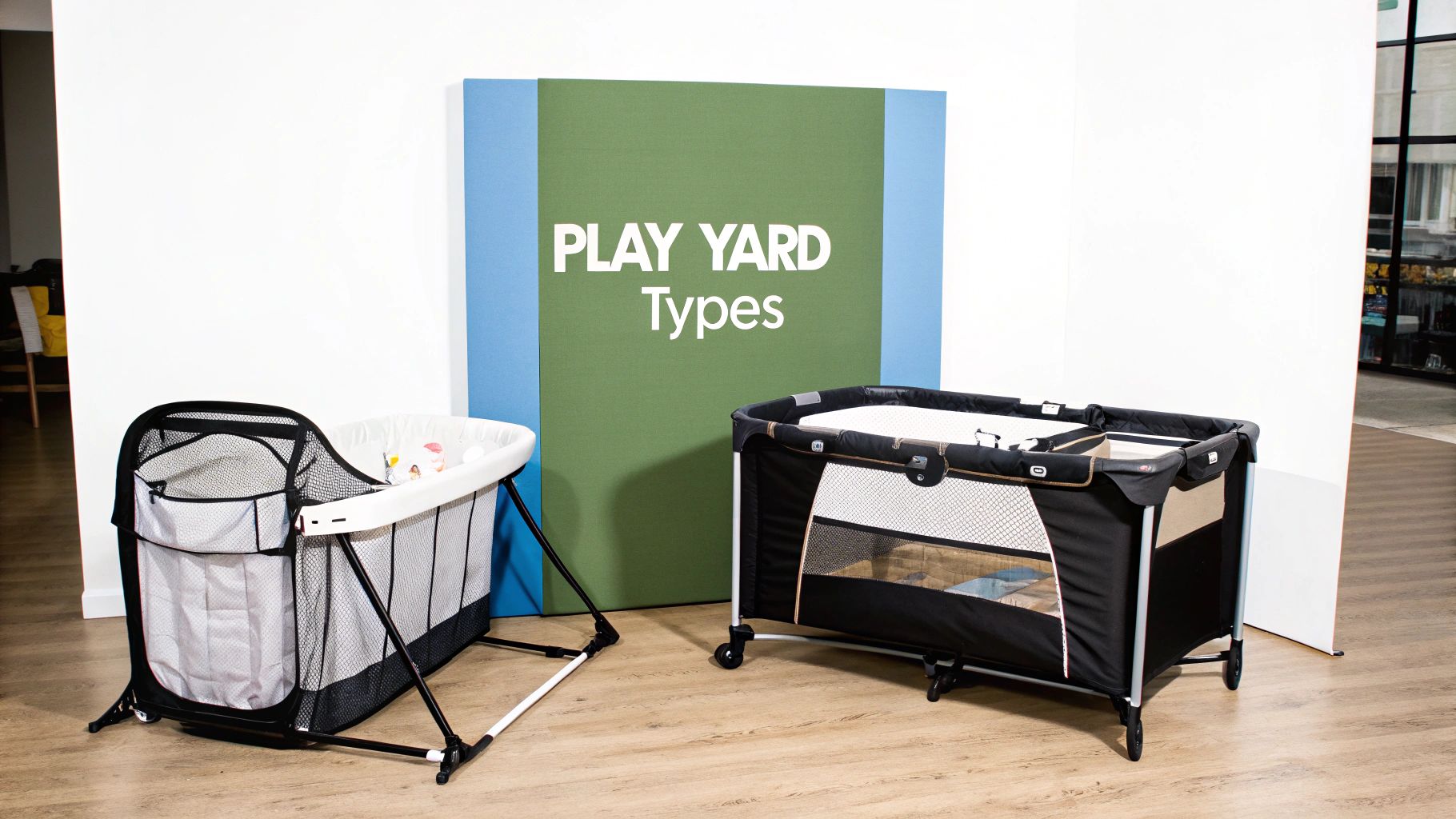
It’s a bit like buying a car. You wouldn't get a two-seater sports car for a family of five, right? In the same way, a super-lightweight, streamlined play yard is perfect for travel, while a loaded model with all the bells and whistles might be a better fit as a permanent fixture in your living room. Let’s look at the main options you’ll come across.
The Basic Play Yard
This is your classic, no-frills model. A Basic Play Yard is all about doing one thing well: giving your baby a secure place to play or nap. These are typically the lightest and most compact options, and they’re incredibly simple to pop open and fold away.
This straightforward design makes them the go-to choice for families who are always on the move. If you’re heading to the grandparents' house for the weekend or taking a family vacation, a basic model is a lifesaver. Less stuff means a lower price tag, but you're not skimping on the critical safety features like a strong frame and breathable mesh sides.
The Bassinet Play Yard
A step up from the basic model is the Bassinet Play Yard. This is probably one of the most popular types, and for good reason—it comes with a removable, raised sleeping area perfect for newborns. That higher level means you don’t have to bend all the way down to the floor to pick up your tiny infant, which your back will thank you for, especially in those early postpartum days.
This bassinet insert is a game-changer for the first few months. It creates a cozier, more contained space that feels just right for a brand-new baby. Once your little one starts pushing up on their hands and knees or sitting up, you just take the bassinet out. Voilà, you have a full-sized play space for your bigger baby to safely hang out in.
One of the biggest wins for the bassinet feature is that it makes room-sharing so much easier. It lets your newborn sleep right by your bed in their own safe spot, which is exactly what pediatricians recommend for safer infant sleep.
The Care Station Play Yard
If you’re looking for the Swiss Army knife of baby gear, you’ve found it. The Care Station Play Yard is designed to be a complete, all-in-one hub for your baby. Think of it as a mini-nursery you can set up anywhere in your home.
These powerhouse models often come loaded with attachments, including:
- A Flip-Away Changing Table: A sturdy, wipeable surface for diaper changes that you can move out of the way when you don't need it. Keeping things hygienic is a breeze.
- Parent Organizers: Little pockets and caddies attached to the side are perfect for stashing diapers, wipes, and rash cream so everything is right where you need it.
- Soothing Add-Ons: It's common to find these with extras like a mobile, a gentle vibration feature, or even a sound machine to help soothe a fussy baby.
This type is absolutely perfect if you want to create a secondary baby station in your main living area, saving you dozens of trips to the nursery throughout the day. When you're comparing models, make sure to check the quality of the attachments—you want them to be durable but still soft and safe for your baby.
The Non-Negotiables: What Makes a Play Yard Truly Safe
When you're looking for a play yard, you're not just buying a piece of baby gear—you're creating a safe space for your little one. Safety isn't just one feature on a list; it’s the whole point. Think of yourself as a safety inspector, because the details really, really matter. These aren't just "nice-to-haves." They're the absolute must-haves that keep your child out of harm's way.
Your first stop should be the certification sticker. Keep an eye out for the JPMA (Juvenile Products Manufacturers Association) certification seal on the product itself or its packaging. This little seal is a big deal. It means the play yard has been put through the wringer by independent labs to meet strict safety standards from groups like ASTM International. It's like getting a stamp of approval from the pros, giving you peace of mind that it’s built to be safe and durable.
Why Breathable and Hypoallergenic Materials Are Key
A baby’s skin is incredibly sensitive and much more absorbent than ours, which means they're prone to rashes and irritation. That's why the materials touching their skin all day are a huge part of the safety equation.
You'll notice the best play yards always have breathable mesh sides, and there’s a good reason for that. First, that mesh keeps air circulating, so your baby won't get too hot while they're playing or napping. More importantly, if your baby rolls over and presses their face against the side, they can still breathe easily. It’s a simple design choice that dramatically lowers the risk of suffocation.
But it’s not just about being breathable. The fabrics should be gentle, too. Look for models made with non-toxic and hypoallergenic materials. This means they're free from nasty chemicals like phthalates, lead, and BPA that can irritate the skin or cause other health problems. Choosing baby-safe fabrics creates a clean, comfortable environment, so you can worry less about mystery rashes and more about playtime.
A sturdy, well-built frame is the skeleton of a safe play yard. It must be strong enough to withstand a toddler pulling up, shaking the sides, and leaning against it without any risk of tipping over or collapsing.
A Rock-Solid Frame and Locks That Actually Lock
While the right materials protect your baby's delicate skin, the frame and its locking system protect their whole body. A wobbly, unstable play yard is a recipe for disaster.
When you're checking out a model in a store or assembling one at home, give it a good shake and look for these key structural features:
- A Solid, Stable Frame: It should feel completely sturdy, with no wobbling. The legs are often spread wide to give it a low center of gravity, which makes it much harder for an adventurous toddler to tip over.
- Secure Locking Mechanisms: The locks on the top rails need to be tough. The best ones require two separate actions to release, making it nearly impossible for a curious child to accidentally collapse the side.
- No Sharp Edges or Pinch Points: Do a quick "hand check." Run your hands along the top rails, corners, and joints. Everything should be smooth and rounded. Any folding parts should be covered to keep little fingers from getting pinched.
At the end of the day, a truly safe play yard is a combination of smart engineering and high-quality, non-toxic materials. By prioritizing that JPMA seal, breathable mesh, gentle fabrics, and a rock-solid frame, you're not just getting a convenient place for your baby to hang out—you're building a genuine safe haven.
Play Yard vs. Playpen: What's the Real Difference?
If you feel like you're drowning in a sea of baby gear terminology, you're definitely not alone. Parents often hear terms like play yard, playpen, and Pack 'n Play used interchangeably, but they don't always mean the same thing. Nailing down the subtle but crucial differences will help you pick exactly what your family needs.
Let's clear up the biggest point of confusion right away: branding. "Pack 'n Play" is simply the brand name for Graco's hugely popular line of play yards. It's a classic case of a brand name becoming the generic term, like calling any tissue a "Kleenex." So, when people say Pack 'n Play, they are almost always referring to a modern play yard.
The real distinction is between a modern, multi-functional play yard and a more old-school traditional playpen. A play yard is built to be a safe spot for both sleep and contained play, almost always coming with a firm mattress pad and often including handy attachments like a bassinet. In contrast, a traditional playpen is usually just a simple, larger enclosure designed only for playtime, with less emphasis on portability or sleep-safe features.
Understanding the Key Distinctions
So, how do these differences play out in real life? Think of a modern play yard as an all-in-one baby station. Its main job is to provide a safe sleep space that can also serve as a play area, making it a lifesaver for travel or for setting up a secondary "nursery" downstairs. That dual-purpose design is a major win for many parents.
A traditional playpen, on the other hand, is all about creating a big, secure play zone. You'll often see them made of interlocking plastic panels or a basic frame. The focus isn't on fancy features like mattresses but on giving a crawling baby or toddling toddler plenty of room to roam safely.
To cut through the noise, let's break it down in a simple table.
Comparing Your Baby Gear Options
| Feature | Play Yard / Pack 'n Play | Traditional Playpen |
|---|---|---|
| Primary Use | Safe sleep and contained play | Contained play only |
| Portability | High; designed to fold compactly for travel | Low; often bulky or requires disassembly |
| Included Mattress | Yes, a thin, firm, sleep-safe mattress | No, not designed for sleep |
| Common Materials | Mesh sides, metal/plastic frame, padded top rails | Plastic panels, wood, or basic mesh |
| Extra Features | Bassinet, changing table, storage organizers | Minimal to none; focuses on space |
This comparison makes it clear: if you need a portable sleep solution that doubles as a play space, a play yard is your best bet. If you just need a large, stationary "yes-space" for your little one to play in at home, a traditional playpen might fit the bill.
No matter what you call it, your number one priority is safety. This decision tree is a great visual checklist for what to look for.
As you can see, essentials like JPMA certification, breathable mesh walls, and a sturdy frame are non-negotiable, regardless of the brand or type.
The Evolution of Safe Play Spaces
The idea of a contained play area is nothing new. After World War II, the baby boom led to a 200% jump in playpen patents between 1945 and 1965. Today’s models are worlds away from those early designs, with an estimated 15% of 2025 models expected to include app-monitored features.
Most importantly, these modern improvements have had a huge impact on safety. According to market analysis, today's play yards are linked to 50% fewer unsupervised injuries compared to older, less-regulated methods, a statistic that perfectly aligns with global health guidelines promoting enclosed play for babies.
Choosing between a play yard and a playpen often comes down to one question: Do you need a safe place for your baby to sleep and play, or just play? A play yard solves both problems, while a traditional playpen focuses on just one.
Ultimately, whether you choose a play yard, a Pack 'n Play, or a simple playpen, its job is to give you peace of mind and your baby a secure environment. This safe space isn't just for playtime; it's also a fantastic tool for building independent sleep habits. Having that familiar, cozy spot can be incredibly comforting for a child.
As you start thinking about the next steps in your baby's sleep journey, our guide on how to transition a baby to a crib offers some great, practical tips for making that move a smooth one.
How to Keep Your Play Yard Clean and Hygienic
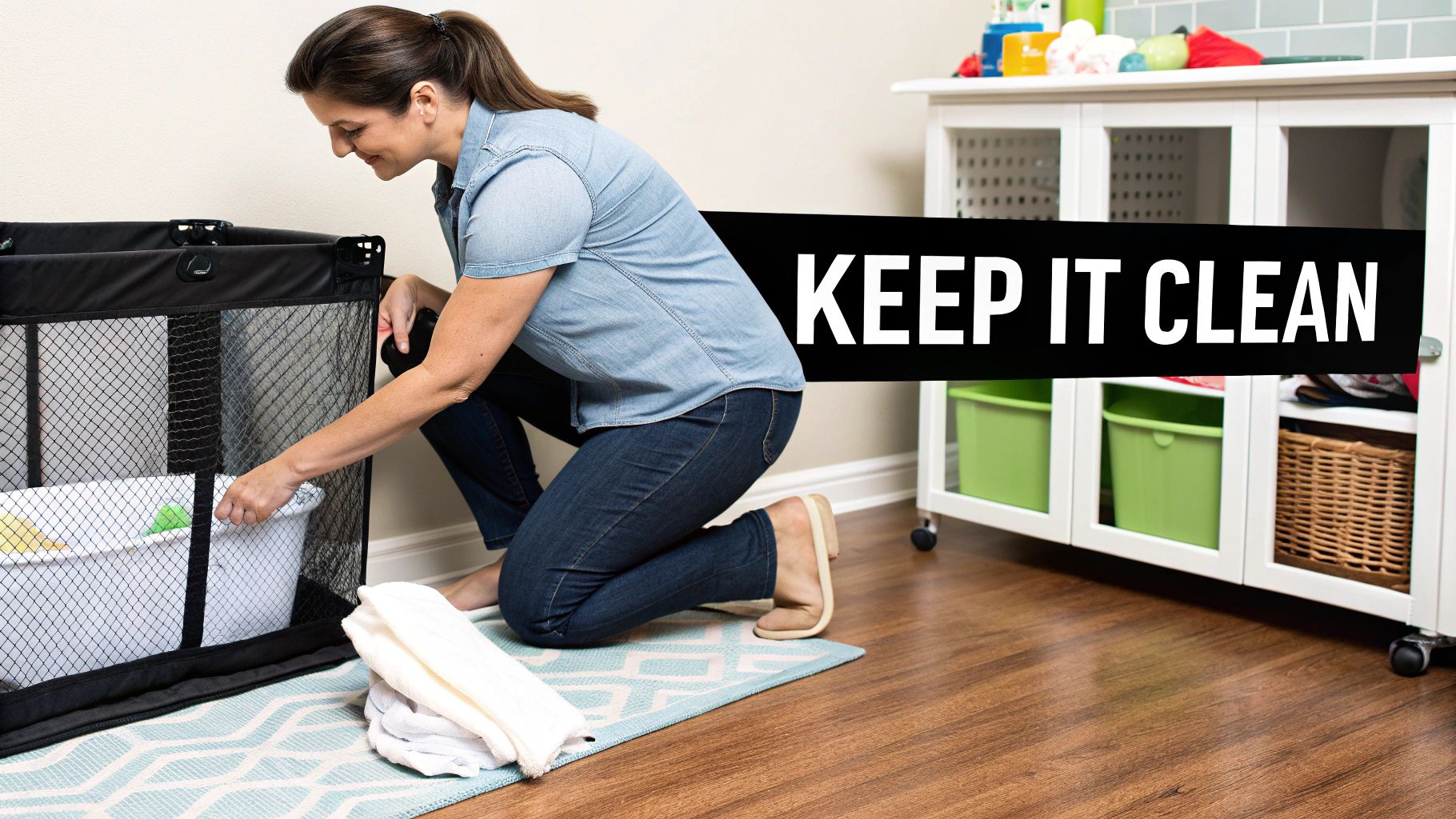
Let's be honest—where babies go, messes follow. A clean play yard isn't just about appearances; it’s a crucial part of keeping your little one healthy and safe. It's so easy for crumbs, drool, and germs to build up, turning your baby's favorite spot into a breeding ground for bacteria that could lead to rashes or allergies.
Think of it like your own laundry. You have your daily upkeep and then the bigger, more thorough washes. A little bit of regular cleaning makes those deep cleans so much less of a chore and keeps the space fresh day-to-day.
The Daily Spot-Cleaning Routine
For the everyday messes, a quick spot-clean will be your go-to move. Spills and spit-up are just part of the baby package, and tackling them right away stops stains from setting in and keeps things sanitary.
All you need is a damp cloth and some mild, baby-safe soap. A simple 50/50 mix of white vinegar and water also works wonders. Just gently wipe down the messy spot, then go over it with a clean, damp cloth to rinse off any soap or vinegar. That's usually all it takes to keep things looking good.
Nailing the Deep Clean
About once a month—or after any major mess (we’ve all been there)—it's time to roll up your sleeves for a deep clean. This ensures you get into every nook and cranny, protecting your baby's delicate skin from anything lurking out of sight.
- Start With a Good Vacuum: First, take everything out—toys, bedding, the works. Grab your vacuum and use the brush attachment to get all the crumbs, dust, and lint out of the mattress, mesh sides, and corners.
- Wash All the Fabrics: Most play yards have a cover or sheet that you can toss in the wash. Always check the manufacturer's tag first, but a gentle cycle with a baby-safe, hypoallergenic detergent is almost always the right call. To make life easier, a dedicated pack and play sheet that you can quickly remove and wash is a game-changer.
- Scrub Down the Structure: Use your baby-safe cleaning solution to wipe down the entire frame, including the top rails and legs. Don't forget the mesh siding! Give it a gentle scrub on both the inside and outside to get rid of any grime.
A quick pro-tip: Always stick to non-toxic, fragrance-free cleaners. Harsh chemicals can leave residues that might irritate your baby's skin or even cause respiratory issues. Natural solutions are safer and just as effective.
Drying is the final, and most important, step. Never pack up or store a play yard while it's still damp—that’s a recipe for mold and mildew. Let every piece air dry completely. If you can, set it up in a sunny spot; the sun is a fantastic natural disinfectant. A truly clean play yard gives your baby the safe, healthy space they need to play and grow.
Choosing the Right Play Yard for Your Family
Picking out the perfect play yard can feel like a huge decision, but it doesn't have to be. The trick is to tune out the noise and focus on what your family actually needs.
Think of it less as buying a product and more as finding a safe, practical space that makes your life as a parent just a little bit easier.
So, where do you start? Begin by thinking about your daily routine. If you're a family that’s always on the go, a lightweight model that folds up in a flash is going to be your best friend. But if you’re looking for a stationary command center for the living room, then features like a built-in bassinet and a changing station suddenly become non-negotiable.
Key Factors to Consider Before Buying
To cut through the options, it helps to ask yourself a few pointed questions. Your answers will immediately narrow the field and point you toward the right choice.
- How much space do you have? Before you do anything else, grab a tape measure. Know exactly how much floor space you can spare, because a play yard that’s too big for the room is an instant headache.
- How often will you travel with it? Be honest here. If it's going to be a travel staple, pay close attention to the folded dimensions and weight. A heavy, clunky model will get left in the garage more often than not.
- What is its long-term value? Look for a play yard that can grow with your child. A model that converts from a newborn napper to a toddler play space offers way more bang for your buck.
At the end of the day, the best play yard is one that meets top-tier safety standards while actually fitting into your life. Always look for models with JPMA certification and prioritize materials that are gentle on your baby’s skin.
Speaking of materials, a sturdy frame is only half the battle. Choosing high-quality, hypoallergenic fabrics is crucial for preventing rashes and other skin irritations. If you're building out your registry, our newborn essentials shopping list is a great place to see what else you'll need.
By keeping these practical points in mind—from how easy it is to set up to the quality of the fabrics—you'll be able to confidently pick a play yard that’s a safe, comfortable, and reliable spot for your little one.
Got Questions? Let's Talk Play Yard Safety
It's one thing to know what a play yard is, but it's another to feel completely confident using one with your little one. Don't worry, every parent has questions! Let's clear up some of the most common concerns.
Answers to Your Top Safety and Use Questions
How long can my baby sleep in a play yard?
A play yard that meets modern safety standards is perfectly safe for all sleep, including overnight. In fact, many parents use it as their baby's main sleep space for the first year. It’s a great option for room-sharing since it provides the firm, flat surface that pediatricians recommend.
Is it okay to add a softer mattress for more comfort?
This is a hard no. You should never add an extra mattress, pillow, or any kind of soft bedding to a play yard. It might seem like a good idea, but it creates dangerous gaps between the mattress and the mesh sides, which is a serious suffocation risk.
Always, always stick with the thin, firm mattress that came with the play yard.
The mattress included with your play yard might feel a bit stiff to you, but it’s designed that way for a reason. That firm, flat surface is exactly what experts recommend to reduce the risk of SIDS and help your baby breathe safely.
When is it time to stop using the play yard?
You'll need to pack it away once your child hits any one of these milestones:
- They reach the height limit (usually 35 inches).
- They exceed the manufacturer's weight limit.
- They figure out how to climb out.
Whichever comes first, it’s time to retire the play yard. This is all about preventing falls and injuries as your little one gets bigger, stronger, and much more adventurous!
At GUGUTON LLC, our goal is to give you peace of mind with high-quality, safe, and comfortable gear for every step of your baby's journey. Explore our collection and find the perfect safe space for your little one at guguton.com.