

Kids Shoe Size Conversion Chart for the Perfect Fit
Trying to find the perfect pair of shoes for your child can feel like a guessing game, especially when you're dealing with sizing from all over the world. A kids shoe size conversion chart is your best friend here. It helps translate sizes between the US, UK, and Europe (EU), so you can buy with confidence, no matter where the shoes are from. This guide will walk you through a simple chart and offer some real-world advice to make sure you get a safe, comfortable fit that protects your child's sensitive skin every single time.
Why a Proper Shoe Fit Is So Important
Getting your child's shoe size right goes way beyond just making sure they're comfortable—it's a big deal for their health and safety. Feet are still developing, and shoes that fit well give them the support they need. A good fit helps head off problems like blisters and ingrown toenails, and it even provides a stable base to prevent trips and falls.
The materials matter just as much, especially for delicate skin. High-quality, breathable fabrics are key to preventing skin irritation, rashes, or even allergic reactions. Keep an eye out for soft, natural materials that are free from harsh chemicals and allow their feet to breathe. This focus on quality is the first line of defense against skin issues.
When you start shopping, you'll quickly see that sizing isn't universal. Most of the shoes you’ll find use United States (US), United Kingdom (UK), or European (EU) measurements. For younger kids, especially toddlers between 1 and 5 years old, you'll typically be looking at sizes from US 5.5 to 12, which is about UK 4.5 to 11, or EU 21 to 30. There's a pretty standard conversion: for example, a child in a US size 6 shoe would likely need a UK size 5 or an EU size 22. For a deeper dive, you can find more details on international shoe sizing on Kiwisizing.com.
Key Considerations For a Healthy Fit
To make sure your child’s feet are happy and well-protected, keep these simple tips in mind:
- Sufficient Wiggle Room: You should always leave about a thumb's width (that’s roughly half an inch) of space between their longest toe and the tip of the shoe. This gives them room to move and grow.
- Secure Heel Fit: The back of the shoe should hold their heel snugly. If it’s slipping off when they walk, it's too big and won't provide the stability they need for running and playing.
- Breathable, Skin-Safe Materials: Look for shoes made from soft, natural materials like leather, canvas, or cotton. Good airflow keeps their feet dry and significantly lowers the chance of skin allergies, rashes, or irritations caused by trapped moisture and sweat.
- Flexible Soles: A flexible sole is a must, particularly for toddlers. It allows their feet to bend and move naturally, which is crucial for healthy foot development.
How to Accurately Measure Your Child’s Feet at Home
Before you dive into any shoe size chart, you need the most important number of all: your child’s actual foot measurement. Getting this right is the first step to a comfortable, safe fit. After all, a bad measurement can lead to shoes that pinch, cause blisters, or even become a tripping hazard.
The good news is you don't need any fancy equipment. You can get a reliable measurement right at home with just a few basic supplies.
For the most accurate reading, it's best to measure in the late afternoon or evening. Feet tend to swell slightly throughout the day, so this timing gives you their largest size. Have your child stand on a piece of paper, making sure their weight is balanced on both feet. Standing straight is key, as it ensures their foot is fully spread out.
A Simple Step-by-Step Measuring Guide
If you want a deep dive into the process, our guide on how to measure kids' shoe size has even more great tips. But here are the basic steps to get you started:
- Trace the Foot: Take a pen or pencil and trace a clear outline around your child's foot. Keep the pen held straight up, not at an angle, to get a true-to-size tracing. If you’ve got a squirmy toddler, try making it a fun game!
- Measure the Length: Now, grab a ruler or tape measure. Measure the distance from the very back of the heel to the tip of the longest toe. Fun fact: for many kids, the longest toe isn't always the big toe.
- Measure Both Feet: It's completely normal for one foot to be slightly larger than the other. Always measure both and use the measurement from the bigger foot to pick a size.
- Add Room for Growth: This is a crucial step. You need to add about half an inch (or 1.25 cm) to the length you just measured. This "wiggle room" gives their toes space to move and leaves a little extra room for those inevitable growth spurts.
A simple rule to live by: Measure the foot, then add half an inch. This ensures the shoe supports their foot without being restrictive, which is so important for healthy bone and muscle development.
Tips for Measuring Wriggly Toddlers
Let’s be honest—getting a toddler to stand still can be a real challenge. A few simple tricks can make the process much smoother. You could turn it into an art project or try measuring while they're distracted by their favorite TV show. While a standing measurement is ideal, you can even try tracing their foot while they’re asleep if all else fails.
Taking just a few minutes to measure correctly gives you the perfect starting point. An accurate measurement is your key to using any kids' shoe size chart effectively and finding shoes that will support your child’s feet as they run, jump, and explore.
Your Complete Kids Shoe Size Chart by Age
Once you have that all-important foot measurement, a solid shoe size conversion chart is your best friend. While a child’s age can give you a ballpark idea, it’s the actual length of their foot that matters most for getting a great fit. A detailed chart is key, helping you switch between different international sizing systems—like US, UK, and European—without any guesswork.
This is critical because kids' feet grow through very specific stages, and shoe sizing is built around these developmental milestones. For instance, tiny infants up to 9 months old usually fall into US sizes 0-3 (that’s UK 0-2 or EU 15-18). Then comes the toddler stage, from 9 months to 4 years, where sizes jump from a US 3.5 all the way up to a 10. You can explore these categories in more detail at Zappos.com. This age-based approach is how brands design shoes that give growing feet the right kind of support.
Navigating the Sizing Categories
To simplify things, we’ve organized our shoe size conversion chart by the four main developmental stages. Each section lines up US, UK, and EU sizes with the corresponding foot length in both inches and centimeters. This way, you’re covered whether you're shopping online or looking at an international brand.
- Infants (0-9 months): At this age, shoes are really more about keeping little feet warm and protected. The soles should be incredibly soft and pliable, made from breathable, natural materials to be gentle on sensitive skin.
- Toddlers (9 months - 4 years): Once they’re taking those first steps, toddlers need shoes with flexible soles and a good grip to help them stay steady. A secure fit and skin-friendly materials are a must to prevent tumbles and irritation.
- Little Kids (4-7 years): This is the running, jumping, and playing-hard stage. Their shoes need to be tougher, with more support and cushioning to keep up with their activity level while still being breathable.
- Big Kids (7-12 years): By now, their feet are much more developed. Shoes start to look more like adult versions but are still engineered for a child’s unique foot structure, prioritizing both support and quality materials.
Before you dive into the charts, this visual guide breaks down the simple steps for getting an accurate measurement.
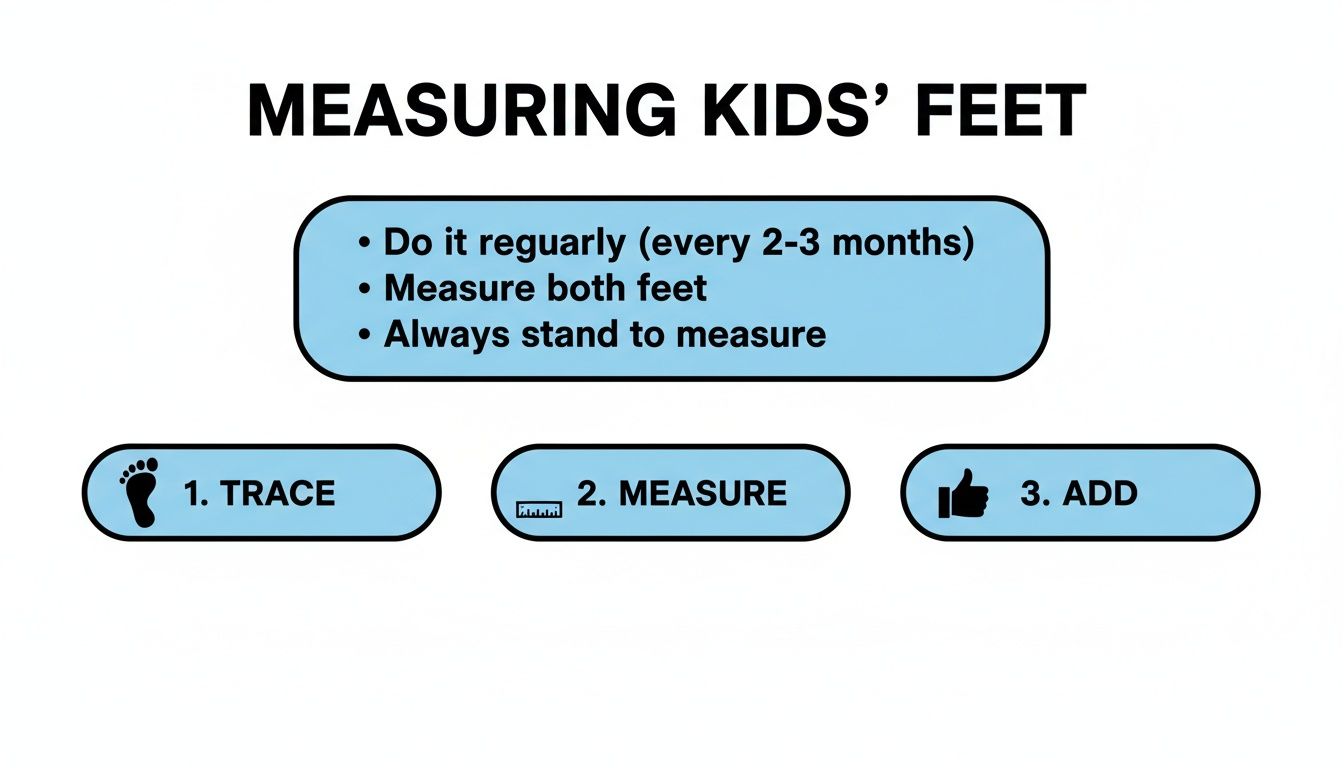
As you can see, the process is straightforward: trace the foot, measure the length, and add a little extra room for growth. Nailing these steps is the foundation for using any size chart correctly and finding shoes that are both safe and comfortable.
Using the Conversion Charts
When looking at the charts, always start with your child’s foot measurement in inches or centimeters—it's the most accurate data point you have. Find that number in the table, then scan across the row to see the equivalent sizes for the US, UK, and EU. Oh, and a quick pro tip: if one foot is slightly bigger than the other (which is very common!), always use the measurement of the larger foot.
Getting the right fit for shoes is just as important as for clothes. If you're looking for more guidance on that, you might find our guide on baby clothing size charts helpful, too.
What Do Those Shoe Size Numbers Actually Mean?
Ever looked at a kids' shoe size conversion chart and wondered where those numbers come from? It's not just a random system. There's a real mathematical logic behind it all, but the rules change depending on where the shoes are from. Getting a handle on these sizing formulas can shed some light on why one brand fits so differently from another and why a simple conversion doesn't always tell the whole story.
Different parts of the world developed their own sizing methods, which is why a good kids shoe size conversion chart is a parent's best friend. The US and UK systems, for instance, are based on an old-school unit of measurement. The European system, on the other hand, is much more straightforward and based on the metric system. This is the root cause of all the sizing headaches we run into.
The Math Behind US Sizing
In the United States, the sizing formula is linked to inches and a quirky old unit called a "barleycorn," which is exactly 1/3 of an inch. The standard US formula for children's shoes is: child shoe size = 3 × last length (in inches) − 11¾.
A similar calculation, based on the child's actual foot, is roughly 3 × foot length (in inches) − 9¾. These formulas show that US kids' sizes start at size 0, which lines up with a foot length of about 3 and 11/16 inches. If you're curious about the history, you can find more details on these traditional sizing systems on Wikipedia.
How European Sizing Compares
The European Union (EU) system is refreshingly simple by comparison. It's directly tied to the length of the shoe's inner sole (the last), measured in a unit called "Paris points." One Paris point is equal to 2/3 of a centimeter.
So, a shoe with an inner length of 15 cm would be a size 22.5 (because 15 × 1.5 = 22.5). This direct link to metric measurements usually makes EU sizing more consistent across the board, but you'll still find small variations due to manufacturing differences.
Key Takeaway: The US system relies on an inch-based formula with an arbitrary starting point, while the EU system is a direct metric measurement. This fundamental difference is why a perfect, one-to-one conversion is often impossible.
Knowing how these formulas work helps explain those small but critical variations you find between different brands. Beyond the charts, it's also wise to check for brand-specific advice. For example, if you're buying a popular brand like Uggs, it's a good idea to consult a complete sizing guide for Uggs to learn about their specific fit. At the end of the day, these sizing systems are just guides. The best path to a safe, comfortable fit is always combining them with an accurate measurement of your child's foot.
Why the Right Fit Is Crucial for Your Child’s Health
A kids' shoe size conversion chart is a fantastic starting point, but getting the perfect shoe for your little one is about more than just matching numbers. The right fit is genuinely one of the most important things you can do for your child's health and safety. It directly affects how their feet develop, their posture, and even how confident they feel as they start to walk, run, and explore the world.
When the fit is off, it can set off a chain reaction of problems. Shoes that are too tight are a major red flag because they can squeeze growing feet and cut off circulation. That constant pressure can lead to painful blisters, calluses, and even ingrown toenails. Over the long haul, consistently wearing shoes that are too small can even contribute to more serious foot deformities.
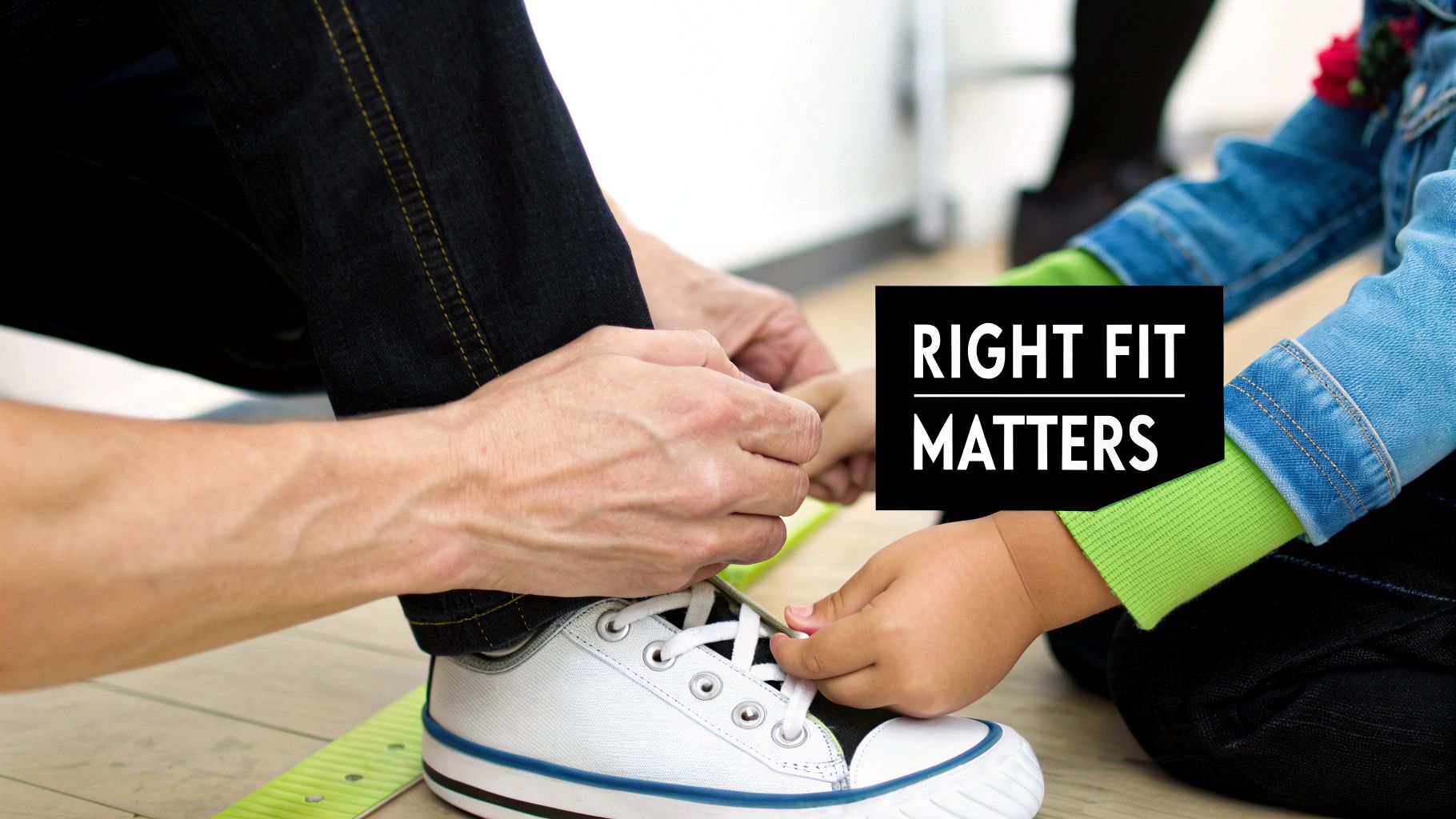
On the flip side, shoes that are too loose come with their own set of dangers. It might seem like a good idea to buy shoes a size up so they can "grow into them," but this can easily backfire. When shoes are too big, a child's foot slides around inside, which causes friction and blisters. Even more concerning, oversized shoes are a serious tripping hazard and don't provide the stable support kids need, increasing the risk of falls and injuries.
The Critical Role of Materials in Preventing Skin Issues
Beyond just the size, the materials a shoe is made from are incredibly important for your child's comfort and skin health. A kid's skin is so much more delicate and sensitive than ours, which makes them prone to irritation, rashes, and allergic reactions from harsh synthetic fabrics or the dyes and chemicals used to treat them.
That's why high-quality shoes made from soft, breathable materials are non-negotiable. Natural fabrics like canvas, leather, and soft cottons let air move freely around the foot. This airflow is key to keeping their feet dry and cool, which dramatically lowers the risk of fungal infections, eczema flare-ups, or other uncomfortable skin problems. To learn more, check out our guide on the impact of fabrics on your baby’s comfort and breathability.
Expert Tip: Always have your child try on shoes while wearing the same type of socks they'll typically use. A thick sock versus a thin one can make a surprising difference in the fit, affecting both comfort and stability.
Actionable Tips for Ensuring the Perfect Fit
Checking for a great fit only takes a minute, and it's a skill every parent can easily pick up. Make these quick checks part of your shoe-shopping routine to keep your child's feet happy, healthy, and protected from skin irritations.
- The Thumb's Rule: With the shoe on, press your thumb down at the very tip. You should feel about a thumb's width (approximately half an inch or 1.25 cm) of space between their longest toe and the end of the shoe. This gives them just enough room to wiggle and grow.
- Check for Heel Slippage: Ask your child to take a few steps and watch the back of their heel. Does it lift out of the shoe as they walk? A snug heel fit is essential for stability and preventing painful rubbing.
- The Width Check: Gently feel along the sides of the shoe. It should feel comfortably snug, not squeezed. If you see the sides of the shoe bulging out, that’s a clear sign that it's too narrow for their foot.
Recognizing When Your Child Needs a Bigger Shoe Size
It feels like kids' feet grow overnight, doesn't it? One minute their shoes fit perfectly, and the next, they're complaining their toes are squished. Keeping up with their footwear isn't just about comfort—it's absolutely vital for their healthy foot development and even their safety.
Catching the signs that a shoe is getting too small can save your child from blisters, discomfort, and potential foot issues later on. The good news is, you don't have to be a mind reader. Your child's feet and their behavior will give you all the clues you need to know it's time for a new pair.
Key Signs Your Child's Shoes Are Too Small
Keep an eye out for these tell-tale signs that it's time to size up. If you spot even one of these, it’s probably a good idea to measure their feet and start looking for the next size.
- Red Marks or Indentations: After you take their shoes off, give their feet a quick check. Any red spots or pressure marks, especially around the toes, heels, or the widest part of their foot, are a dead giveaway the shoes are too tight. These are early warnings of potential skin breakdown or blisters.
- Difficulty Putting Shoes On: Remember when those shoes used to slip right on? If your child is suddenly struggling to get them on, or you find yourself having to really work to get their foot inside, they’ve likely outgrown them.
- Complaints of Foot Pain: This one is straightforward—listen to your child. If they start saying their feet or toes hurt, particularly after a long day of playing, their shoes should be the first suspect.
- Toes Pressing Against the End: Have your child stand up nice and straight. Press your thumb down on the very tip of the shoe. You should feel about a thumb's width of space between their longest toe and the end of the shoe. If you can't, there’s no room left for their feet to move or grow.
How Often to Check for a New Size
Kids grow at different speeds at different ages, so how often you check their shoe size should change, too. Following a regular schedule helps you stay one step ahead of those growth spurts.
A Proactive Approach to Fit: Don't wait for your child to complain about their shoes. By the time they tell you something hurts, the shoes might have been too tight for a while. Regular checks are the best way to keep their feet happy and well-supported.
Here's a handy guideline for how often you should be checking their shoe fit:
- Toddlers (under 3 years old): Check the fit every 2-3 months. Feet grow astonishingly fast at this stage.
- Little Kids (3-6 years old): It’s a good idea to check every 4 months. Growth is still humming along but starts to steady a bit.
- Big Kids (over 6 years old): Checking every 6 months usually does the trick, though you’ll still want to be on the lookout for sudden growth spurts.
By regularly checking their shoe fit and knowing what to look for, you can make sure your child always has comfortable, supportive footwear for all their adventures. And if you've decided it's time for an upgrade, finding a pair they'll love, like these fashionable Mary Jane flats for girls, can make getting new shoes exciting instead of a chore.
Got Questions? We’ve Got Answers.
Figuring out kids' shoe sizes can feel like a guessing game. Even with a sizing chart in hand, you're bound to run into tricky situations that leave you second-guessing your choice. Here, we'll walk through the most common questions we hear from parents, giving you clear, straightforward answers to help you choose the right shoes with confidence.
Let's clear up the confusion, from how much growing room is just right to what happens when they jump from "little kid" to "big kid" sizes.
Should I Buy Shoes a Little Big for My Child to Grow Into?
It’s tempting to buy shoes a size up to get more wear out of them, but it’s a strategy that can backfire. Shoes that are too big don't give a child's developing feet the support they need. Worse, they can be a serious tripping hazard, leading to unnecessary falls and injuries.
When a shoe is too loose, your child's foot will slide around inside, which can cause painful blisters and make their walking pattern unstable. The sweet spot is about a thumb's width of space—roughly half an inch or 1.25 cm—between their longest toe and the front of the shoe. This gives them enough wiggle room for natural movement and a little bit of growth without compromising safety and support.
Are Kids' Shoe Sizes the Same as Adult Sizes?
Nope, and this is a big point of confusion for many parents! Kids' and adults' shoes run on completely different sizing systems. The children's scale is split into stages, usually running up to a size 13.5 in the "Little Kid" range. After that, it does something strange: it resets and starts over at size 1 for "Big Kids" or "Youth."
So, a child will graduate from a size 13 Little Kid shoe straight into a size 1 Big Kid shoe. The largest kids' size is typically a Big Kid size 7, which is about the same as a men's size 7 or a women's 8.5. Because the two systems don't line up, you can't guess one from the other. Always stick to a dedicated kids shoe size conversion chart.
Remember this key transition: The kids' shoe sizing sequence goes from toddler sizes, up to a Little Kid size 13.5, then starts over at Big Kid size 1.
How Do I Convert My Child’s US Shoe Size to UK or EU?
A detailed conversion chart is your best friend here, but if you're in a pinch, there are a couple of handy rules of thumb. Just remember, these are estimates—brands can vary, so always double-check if you can.
- US to UK: A child’s UK size is usually 0.5 to 1 size smaller than their US size. So, if your child is a US 10, they’d likely be a UK 9 or 9.5.
- US to EU: For toddler sizes, a quick way to estimate is to add 16 or 17 to the US size. For example, a US size 7 is roughly an EU 23 or 24.
Again, treat these as ballpark figures. Every shoe manufacturer uses a slightly different last (the foot-shaped mold they build the shoe around), which can affect the final fit. That's why we always point parents back to the detailed charts we've provided earlier in this guide.
What Is the Difference Between Toddler and Little Kid Sizes?
These terms aren't just cute labels; they mark two distinct and consecutive stages in the sizing scale, with shoes designed for different developmental milestones.
Toddler sizes (US 4 to US 10) are for new and early walkers. You'll notice these shoes are incredibly flexible and often have a wider fit. This is intentional—it accommodates the soft, pudgy feet of little ones just learning to get around. Quality here focuses on non-toxic, breathable materials for ultimate safety.
Little Kid sizes (US 10.5 to US 3) pick up right where the toddler sizes end. These are built for more active preschool and early elementary kids. The shoes are more durable, offer more structure and support, and have better traction for all that running, jumping, and playing. The sizing is seamless; a child grows out of a toddler 10 and moves right into a little kid 10.5.
At GuGuTon, we know that getting the right fit is everything. It's about more than just comfort; it's about protecting your child's health with high-quality, skin-safe materials. Take a look at our collection of stylish shoes designed with growing feet in mind. Find the perfect pair today at https://guguton.com.